
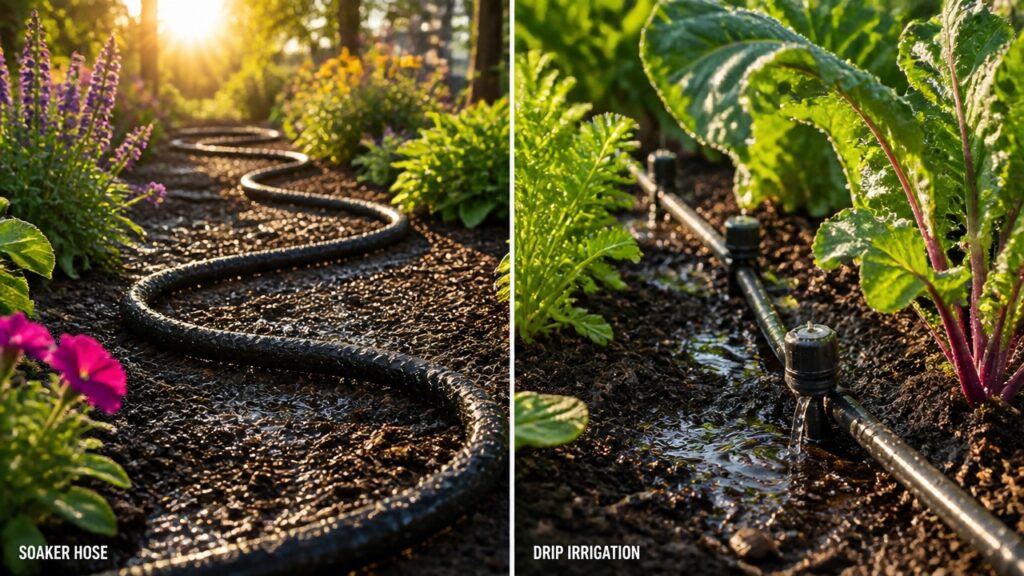
Stand in your garden on a hot afternoon, hose in hand, and you’ll quickly realize that watering matters. The choice between soaker hoses and drip irrigation systems isn’t just about convenience; it shapes how efficiently your plants drink and how much time you spend managing them. Both methods deliver water directly to your garden beds rather than spraying it everywhere, but they work in surprisingly different ways.
Soaker hoses feel like the simpler option because they’re straightforward to set up. You lay them along your garden rows, and water seeps out through countless tiny pores along their entire length. This works wonderfully if you’re watering flower borders or vegetable patches where plants grow close together.
The downside is that water spreads across a wider area, which means some goes to the soil between plants where you don’t necessarily need it.
Drip irrigation systems take a more targeted approach by delivering precise amounts of water directly to individual plant roots. Small emitters attach to tubing and can be positioned exactly where each plant sits, making them ideal for containers, raised beds, or gardens with varied plant spacing.
The trade-off is that installation requires more planning and upfront cost, though many gardeners find the water savings and reduced maintenance pay off over time.
Consider your budget, garden layout, and how hands-on you want to be. Soaker hoses suit gardeners who value simplicity and lower initial investment, while drip systems appeal to those willing to invest more effort for maximum efficiency and control.
Either way, moving beyond hand-watering means your plants get consistent moisture and you get more free time to enjoy your garden.
How Water Flows: The Mechanics of Each System
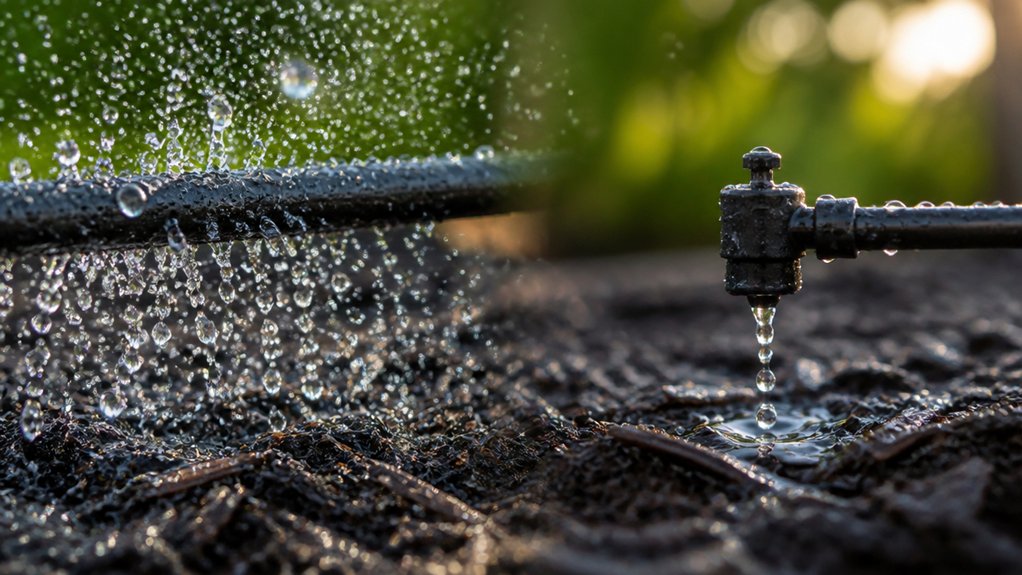
Water moves through soaker hoses and drip irrigation systems in fundamentally different ways, creating distinct advantages for various garden situations.
Soaker hoses release water along their entire length through small perforations, allowing moisture to seep slowly into surrounding soil. This continuous distribution works well for vegetable rows and flower beds requiring even coverage. Water pressure remains moderate and consistent throughout the hose.
Drip irrigation systems, by contrast, deliver water through targeted emitters placed at specific plant locations. Each emitter drips water directly at the soil surface near individual plants, reducing waste and targeting roots precisely. This method suits container gardens and plants with varying water needs.
Both systems operate at low pressure compared to traditional sprinklers, minimizing runoff and evaporation losses while promoting deeper soil penetration and healthier root development.
Soaker Hose vs Drip Irrigation: Cost Breakdown
Because initial investment greatly influences gardening decisions, understanding the price differences between these two watering systems proves essential. Soaker hoses typically cost less upfront, ranging from $10 to $30 for a 50-foot hose. Drip irrigation systems require greater initial spending, averaging $50 to $200 depending on garden size and complexity.
Installation costs differ considerably. Soaker hoses need minimal setup, requiring only connection to a water source. Drip systems demand more labor for laying tubing, adding emitters, and configuring zones.
Long-term expenses favor drip irrigation, however. Soaker hoses deteriorate faster, lasting 3-5 years, while drip systems function 8-10 years. Water savings from drip irrigation reduce monthly bills substantially. Gardeners with smaller budgets prefer soaker hoses initially; those planning permanent installations favor drip systems despite higher costs.
Water Efficiency: Which System Wastes Less?
How much water actually reaches plant roots through each system? Drip irrigation delivers approximately 90 percent of water directly to soil, while soaker hoses achieve roughly 80 percent efficiency. The difference stems from design: drip systems use emitters that release water slowly at precise locations, minimizing evaporation and runoff. Soaker hoses distribute water along their length through small perforations, allowing some moisture to escape into the air before absorption.
In hot climates, drip irrigation’s advantage increases markedly. Soil type matters too; sandy soil loses more water than clay, making drip systems preferable in such conditions.
For typical residential gardens, drip irrigation conserves 20 to 50 percent more water than traditional sprinklers. Soaker hoses still outperform sprinklers substantially, though they trail drip systems in overall efficiency ratings.
How Hard Is It to Install?
Installation difficulty separates these two systems markedly, with soaker hoses offering the simpler approach for most homeowners. Soaker hoses require minimal setup, involving only connection to a water source and positioning along garden beds. Users simply lay the hose, secure it with stakes or clips, and begin watering.
Drip irrigation systems demand more complexity and planning. Installation involves laying main lines, attaching emitters at specific plant locations, and configuring the system layout beforehand. Users must measure distances, calculate water pressure requirements, and potentially bury components underground.
For beginners or renters, soaker hoses present fewer obstacles and lower costs. Drip systems suit established gardens where permanent installation justifies the effort. Both systems function effectively once properly positioned and maintained.
Garden Layout Flexibility
Garden layouts vary considerably, and soaker hoses adapt more readily to changing designs than drip systems. Soaker hoses can be moved, coiled, or repositioned with minimal effort, making them suitable for gardeners who frequently rearrange plant locations. Drip irrigation systems, by contrast, require more planning and installation work to modify once established.
For example, a gardener growing vegetables in raised beds can easily relocate a soaker hose between seasons. A drip system with buried lines and permanent emitters demands more labor to adjust. Soaker hoses work well in informal gardens, container arrangements, and spaces with irregular plant spacing.
Drip systems excel in fixed layouts, such as established shrub borders or permanent vegetable gardens. Gardeners should consider their long-term design plans before selecting either option.
What It Takes to Keep Them Running
Maintaining either system requires regular attention to prevent clogs, leaks, and reduced water flow. Soaker hoses need yearly flushing to remove mineral buildup and debris that accumulates inside the tubing. Drip irrigation systems require filter cleaning, emitter inspection, and line purging at the start and end of each season.
Both systems benefit from consistent pressure monitoring. Low water pressure indicates blockages, while high pressure can damage fittings and connections. Winterization matters in cold climates, draining lines prevents freeze damage and cracking.
Soaker hoses last three to five years before degradation occurs. Drip systems, though initially more expensive, typically function for seven to ten years with proper care. Replacing worn components like emitters and connectors extends system longevity considerably.
Match Soaker Hoses to Your Garden Type
After understanding how to keep soaker hoses functioning well, choosing the right type for specific garden conditions becomes the next practical decision. Different garden layouts call for different soaker hose designs. Flat soaker hoses work best for vegetable gardens and flower beds where plants grow close together. Soaker hoses with emitter spacing suit orchards and larger plants needing water at specific intervals.
Clay soil gardens benefit from soaker hoses that deliver water slowly, preventing runoff and erosion. Sandy soil gardens require hoses with closer emitter spacing due to faster drainage rates. Raised bed gardens perform well with standard soaker hoses laid in single rows. Container gardens need shorter hose sections. Sloped terrain requires hoses with pressure regulators to maintain consistent water distribution throughout.
Match Drip Irrigation to Your Garden Type
How can drip irrigation systems be adapted to match specific garden conditions? Drip systems work well in vegetable gardens, flower beds, and container plantings by delivering water directly to plant roots through small emitters.
For vegetable gardens, drip lines run along rows, reducing water waste on pathways. Flower beds benefit from adjustable emitters that accommodate different plant spacing and water needs. Container gardens use drip lines with individual drippers for each pot, controlling moisture precisely.
Slope and soil type matter greatly. Sandy soils need closer emitter spacing, while clay soils require fewer emitters. On slopes, drip lines prevent runoff better than soaker hoses, maintaining consistent watering across uneven terrain.
Drip systems suit ornamental plantings, raised beds, and large-scale gardens effectively.
Soaker Hose or Drip Irrigation: Choose Your Match
Selecting between a soaker hose and a drip irrigation system depends on garden size, budget, plant types, and water efficiency goals. Soaker hoses work well for small to medium gardens, vegetable beds, and container areas where cost matters. Drip irrigation suits larger spaces, complex landscapes, and situations requiring precise water delivery to multiple zones.
Budget considerations include initial investment and long-term maintenance. Soaker hoses cost less upfront but may need replacement every few years. Drip systems require higher initial spending but last longer and reduce water waste by 50 percent or more.
Plant spacing influences the choice considerably. Densely planted vegetable gardens benefit from soaker hoses, while trees, shrubs, and widely spaced plants favor drip lines with individual emitters. Climate and soil type also determine efficiency and suitability.
Frequently Asked Questions
Can Soaker Hoses and Drip Irrigation Systems Be Used Together in the Same Garden?
Yes, soaker hoses and drip irrigation systems can be used together in the same garden. Gardeners often combine both methods to optimize water delivery to different plant types and areas, creating a customized watering solution that maximizes efficiency and plant health.
How Long Do Soaker Hoses and Drip Irrigation Systems Typically Last Before Replacement?
Soaker hoses practically evaporate after merely 2-3 years of relentless use, while drip irrigation systems stubbornly endure 5-10 years. Factors like UV exposure, water quality, and maintenance dramatically influence their longevity and performance.
Are Soaker Hoses or Drip Irrigation Better for Container Gardening and Potted Plants?
Drip irrigation systems excel for container gardening and potted plants. They deliver water directly to soil with precision control, preventing overwatering. Their adjustable emitters accommodate various pot sizes and shapes, making them more versatile than soaker hoses for containerized environments.
Can Either System Be Used With Rainwater Harvesting or Recycled Water Sources?
A gardener’s saved rainwater transformed her garden from brown to thriving. Both soaker hoses and drip irrigation systems work excellently with rainwater harvesting and recycled water sources, requiring only basic filtration to prevent clogs from sediment.
Which System Is Safer to Use Around Vegetable Gardens and Edible Plants?
Both systems prove equally safe for vegetable gardens and edible plants when properly maintained. Drip irrigation offers slight advantages through precise water delivery directly to soil, minimizing leaf wetness that encourages disease. Soaker hoses require careful placement to avoid contamination risks.
Conclusion
Selecting between soaker hoses and drip irrigation requires matching the system to garden needs. Soaker hoses suit dense plantings with flexible layouts, offering lower costs and simple setup. Drip irrigation, like a precision tool in a gardener’s shed, delivers water directly to roots, reducing waste in fixed garden designs. Consider plant types, water requirements, and long-term conservation goals when deciding which system fits your garden best.